Monday, March 25, 2013

Wayne Thiebaud Cakes

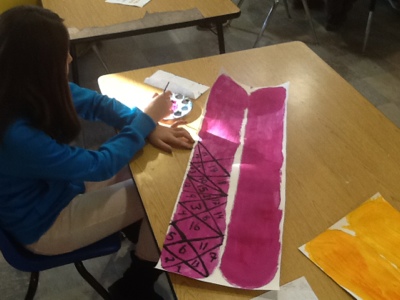
In celebration of our school's 50th Birthday, first and second grade artists learned about Wayne Thiebaud. He was famous for painting pictures of cakes and other sweet treats. We tried to capture the halo effect that Thiebaud called "halination" by outlining with oil pastels before AND after painting with lightened tempera paints.

Some biographical information about Wayne Thiebaud from a great art blog, Art For Small Hands.

The Life of Wayne Thiebaud
Wayne Thiebaud was born in Mesa, Arizona, in 1920. His father worked, among other things, as a mechanic, an inventor, a rancher, and a milkman. When Thiebaud was six months old his family moved to California where he spent a lot of time on his grandfather’s farm. His first art projects were with his mother on rainy days and with his uncle who was a cartoonist. 

For many years Thiebaud did odd jobs like sign painting, cartooning, and illustrating movie posters. One summer he even worked in the animation department of Walt Disney studios. He was almost thirty years old before he realized that he could make a career of painting. When he returned to college to learn about art, he was offered a teaching job and spent many years teaching art in California universities.

At forty years old, he began his series of still-life paintings of food. Drawing with color and correcting his drawings with darker color led to a halo effect around his objects. This outline of pure, intense colors has become known as halation and adds to the vibrancy of Thiebaud’s paintings. He uses bright colors, thick rapid brush strokes, and simplified shapes to paint common, everyday food. Filling his canvas with a single cafeteria-style cake or pie elevates it to an absurd status that is part of his humor. At times he repeats the desserts over and over again, giving the impression that there is no end to these sweet things.

When painting a cake, Thiebaud says that he is painting a picture of an object that has already been painted. It’s as though he transforms the thick rich texture of oil paint into whipped cream or icing as he spreads it across the desserts on his canvas.  


Thursday, February 21, 2013

Chickens!

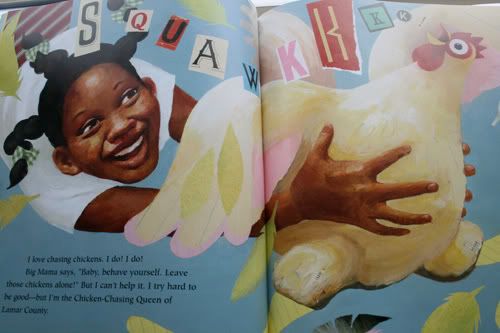
We read "The Chicken Chasing Queen of Lamar County," by Janice Harrington. This book has fabulous collage illustrations by Shelley Jackson, made up of many different types of paper and materials and painting. It was a Red Clover book in 2007, and has been one of my favorite children's books ever since.


To create out chicken collages, we started by collecting texture rubbings from around the room and painting them with watercolor paints, to observe the resist technique. This gave us a variety of beautiful papers to use. We used these papers and other scraps from our scrap cart to create fun and funky chickens.


Kindergartners explore watercolors

Kindergarten artists learned different tips and tricks for watercolor painting. We set up three stations in our art room, each with liquid watercolor paint. The first station had crayons so that they could experiment with watercolor resist. The second had sharpie markers and the third had salt. The salt station was definitely the favorite, as they loved watching the crystalline patterns emerge on their paintings. We will continue to use each of these techniques in our artwork.


Monday, February 18, 2013

Love is in the air!

Kindergarten artists worked collaboratively to create our first completed piece for our Art Auction. The art auction will take place during the Bridge Street Art Fair on Saturday, May 18th and will raise funds to support out wonderful school. To create this beautiful piece, each child chose a favorite color for his or her fingerprints. We filled the large heart shape with dots, then created a signature dot next to each child's name. This project was great for practicing working together, color mixing, shape, space and following directions.


Monday, February 4, 2013

Kindergarten Collage Snowmen

Kindergartners made snowpeople collages. They use paper covered in tissue paper and painted with white paint for the snowballs. We read "Snowballs," by Lois Ehlert and "The First Day of Winter," by Denise Fleming.