Showing posts with label Oil pastel. Show all posts
Showing posts with label Oil pastel. Show all posts
Wednesday, February 14, 2018

Monday, November 6, 2017
Kandinsky's Circles and Shapes

Wassily Kandinsky was born in Russia in 1866. In his early years as an artist, he explored a variety of media but stayed with a traditional, realistic style. Upon traveling through Europe and viewing art by artists such as Matisse and Gauguin, Kandinsky was influenced to bring vibrant colors into his art. When he became a professor a the Bauhaus School in Germany, his art became less objective and contained lines, circles and other geometric shapes.
Kandinsky has been called a "pioneer of modern art." He believed that art should reach the audience though sight, sound and emotion or spiritual connection. He wanted to create art that let the audience decide on the meaning, much like music brings images into the listener's head.

One of Kandinsky's most well known paintings is "Squares with Concentric Circle" (1913).
Kandinsky loved including circles in his work. Here are some other pieces comprised of circles.
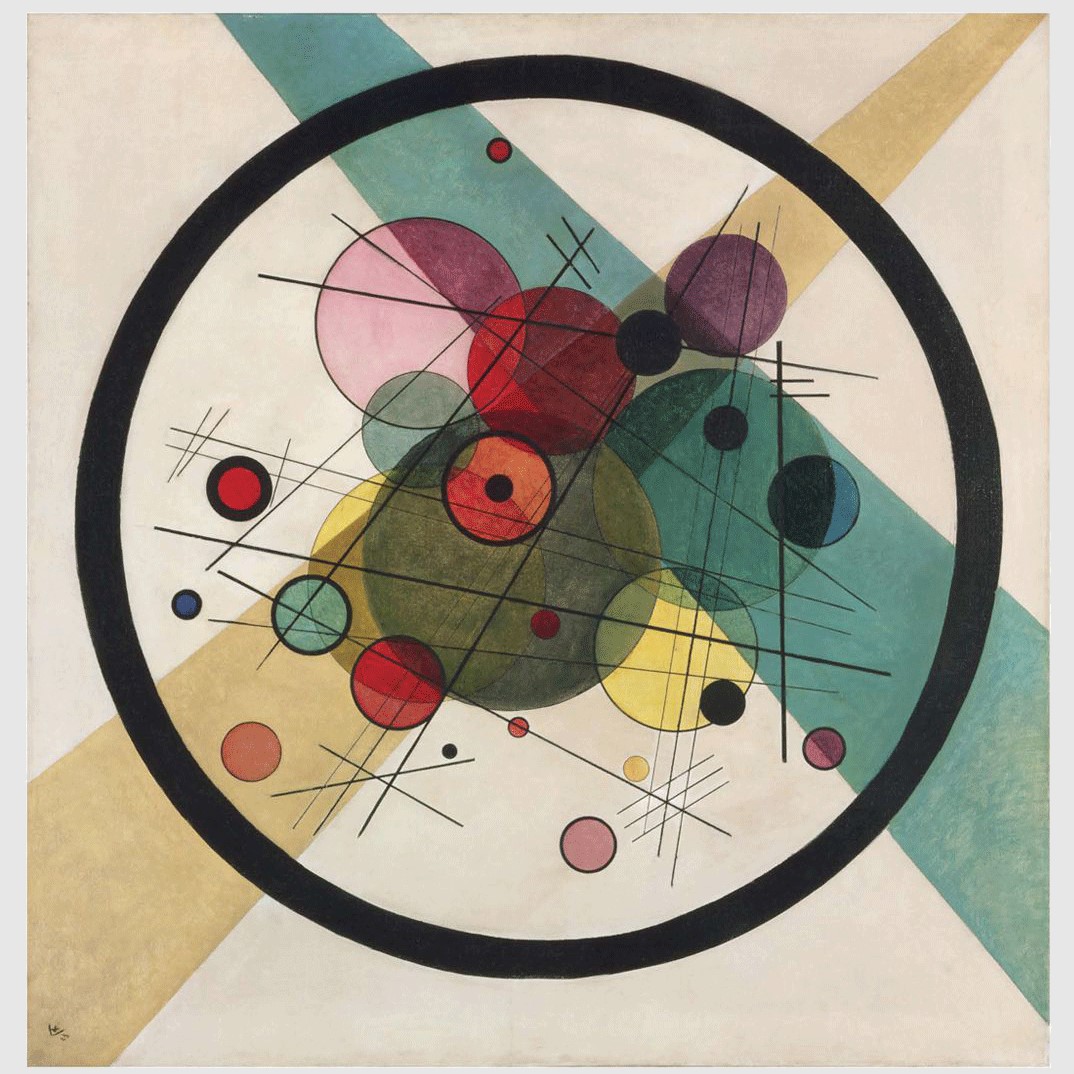


- What do you notice about Kandinsky's work?
- What guesses can you make about the artist?
- What do you like?
- What don't you like?
- Is there anything that you can take from Kandinsky's artwork to inspire your own work?
- How is looking at artwork like listening to music? How is it different?
First and second grade artists competed two piece inspired by the work of Wassily Kandinsky.
For the first project, each student created on square with concentric circles, inspired by Kandinsky's famous painting. We used oil pastels, then observed the watercolor resist technique by painting over our circles with liquid watercolors. We will put these squares together to form a collaborative display.
For the second project, students worked collaboratively to paint a mural inspired by Kandinsky's use of shape, line and color. We started with black paint, then added warm colors, then cool colors.
Click here to explore the connection between art and music with this interactive online game from the Tate Gallery.
CLICK HERE TO SEE THE FINISHED MURALS!
LEARNING TARGETS:
- I can use art vocabulary to describe Kandinsky's work.
- I can identify and explain similarities between Kandinsky's work and my own art work.
- I can work collaboratively with my classmates on our mural.
- I can identify and use warm and cool colors.
VOCABULARY
- Warm/Cool Colors
- Concentric Circles
- Geometric Shapes
- Abstract Art
- Collaborative

Wednesday, October 4, 2017
Kindergarten Leaf and Nature Collages


We also made leaf rubbings with crayons, then painted over them to experience the watercolor resist technique. We added these leaves to our collages.
On yet another beautiful fall day, the kindergarten class headed outside to collage objects from nature for our moveable nature "collages." We shared our materials to create temporary nature collages, which we photographed on the iPad before dismantling.


Our nature collage station:

Wednesday, December 21, 2016
Portraits inspired by Sandra Silberzweig

Sandra Silberzweig is a contemporary artist from Toronto. She has a condition called synesthesia, which is a crossing of the senses. This means that she may "hear" colors or "see" music.
Here is a poem she wrote called "When you are a synesthesia goddess ...... your day dreams are always in color"
I am a synesthesia goddess
I have no fear of color
It lives in my soul, dances in my heart
Spills out of my fingers flowing down a canvas
I can see your aura
Taste the color black
Feel the chill of the green wind
Smell blue butterflies
Hear the yellow rain
Life is never boring when inspiration is always around
Click here to read more about Sandra Silberzweig, the work she has done to share her experience with synesthesia and how she has turned this condition into a driving force for her creative work.
Silberzweig's paintings are bold, colorful and imaginative. She primarily paints stylized, patterned-filled portraits.
I worked with the third and fourth grade classes to create an assessment rubric for this lesson. We talked about what qualities artwork would need to get into the "Wowy-Zowy Zone." Students used this rubric to inspire revisions of their work and self-evaluate. Click here to view this rubric.
Third and fourth grade artists looked at examples of Silberzweig's artwork, then created portraits inspired by her unique style. We used chalk pastel and oil pastel and focused on choosing warm and cool color combinations and creating patterns.


Subscribe to:
Posts (Atom)